
Poorman’s railgun
Idea
When you apply a voltage source of very low internal resistance to two parallel copper buses with a bullet in between them, closing the circuit, several things will happen. Firstly, a very large current will begin to flow through the copper buses and the bullet. The flowing current will create a magnetic field entering the bullet in the top-to-bottom direction. The electrons in the bullet will then experience the Lorentz force of the form F = q(v⃗ × B⃗). After some substitutions, we can derive that the bullet itself will experience a force F = I(l⃗ × B⃗), where l is the length vector whose direction is the electric current direction and whose length is the bullet’s dimension in which the current flows. That’s the physics for this device.
When it comes to engineering, the essential thing is to find a very high current source. Naturally, a capacitor tank or some high-power battery is the solution. Utilizing the battery has some drawbacks: primarily, if no good fuse is used and the bullet gets stuck inside the barrel, the battery might be shorted for a significant amount of time, leading to explosion or fire. In this case, 500V 15mF capacitors were chosen. Unfortunately, they were manufactured somewhere in China, and I couldn’t find any more parameters. The next design choice is whether to use external neodymium magnets to add a static magnetic field. Without them, the current going through the copper buses needs to be really large to generate any significant magnetic field.
The capacitor tank was charged using a variac to allow for control over the energy level stored in the system.
Barrel design
The barrel was constructed as a “sandwich” of several laser-cut layers of acrylic. It consists of various thickness layers that separate the inner channels. In the design, we can see three inner chambers:
- The first one on the top is the upper magnet slot, which fits 18mm x 10mm x 40mm neodymium magnets.
- The next, wider chamber holds the two copper bars, which are spaced with a 5mm gap between them. This gives a 5mm x 5mm gap for the bullet.
- The last gap fits the lower magnet slot.
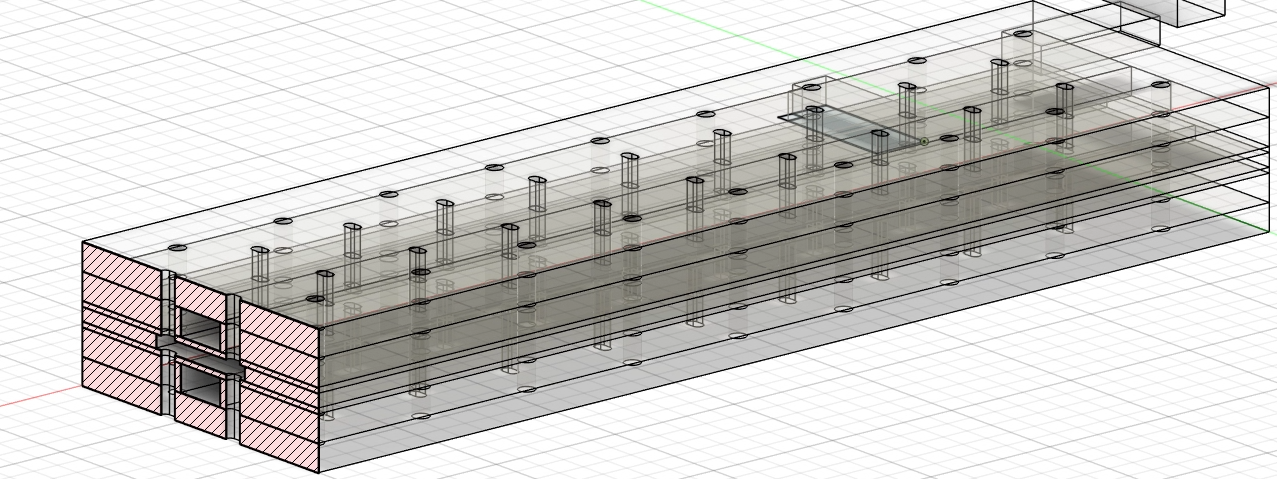
Here is the constructed assembly:
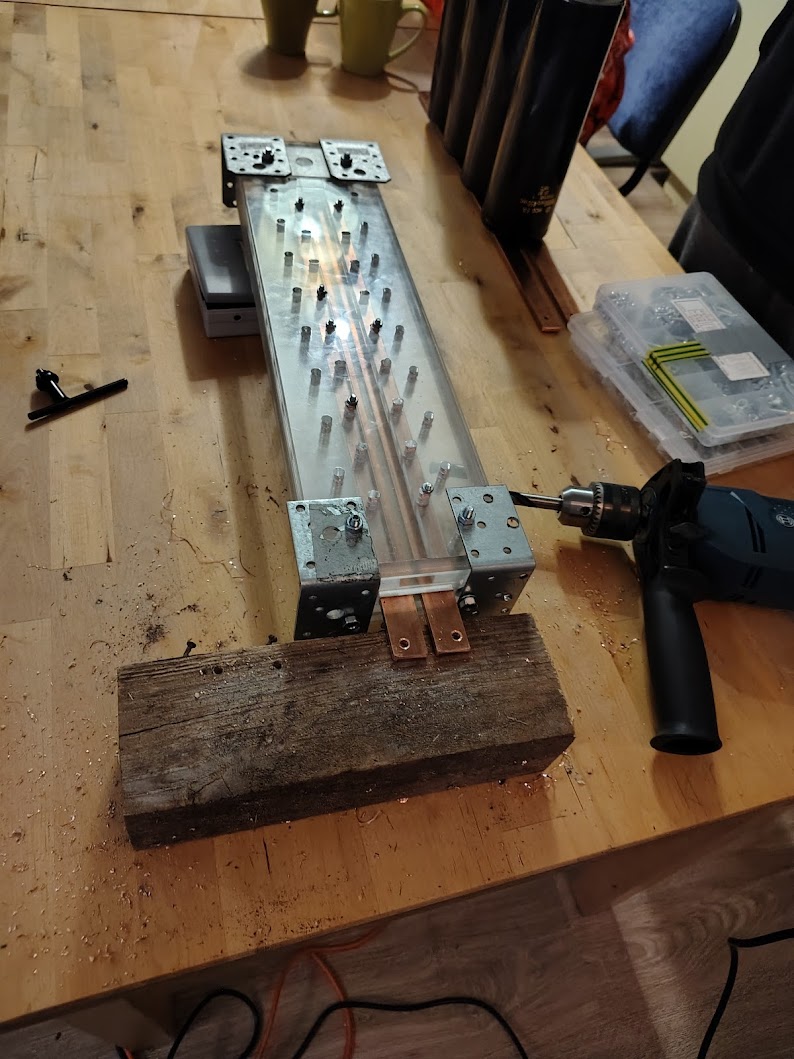
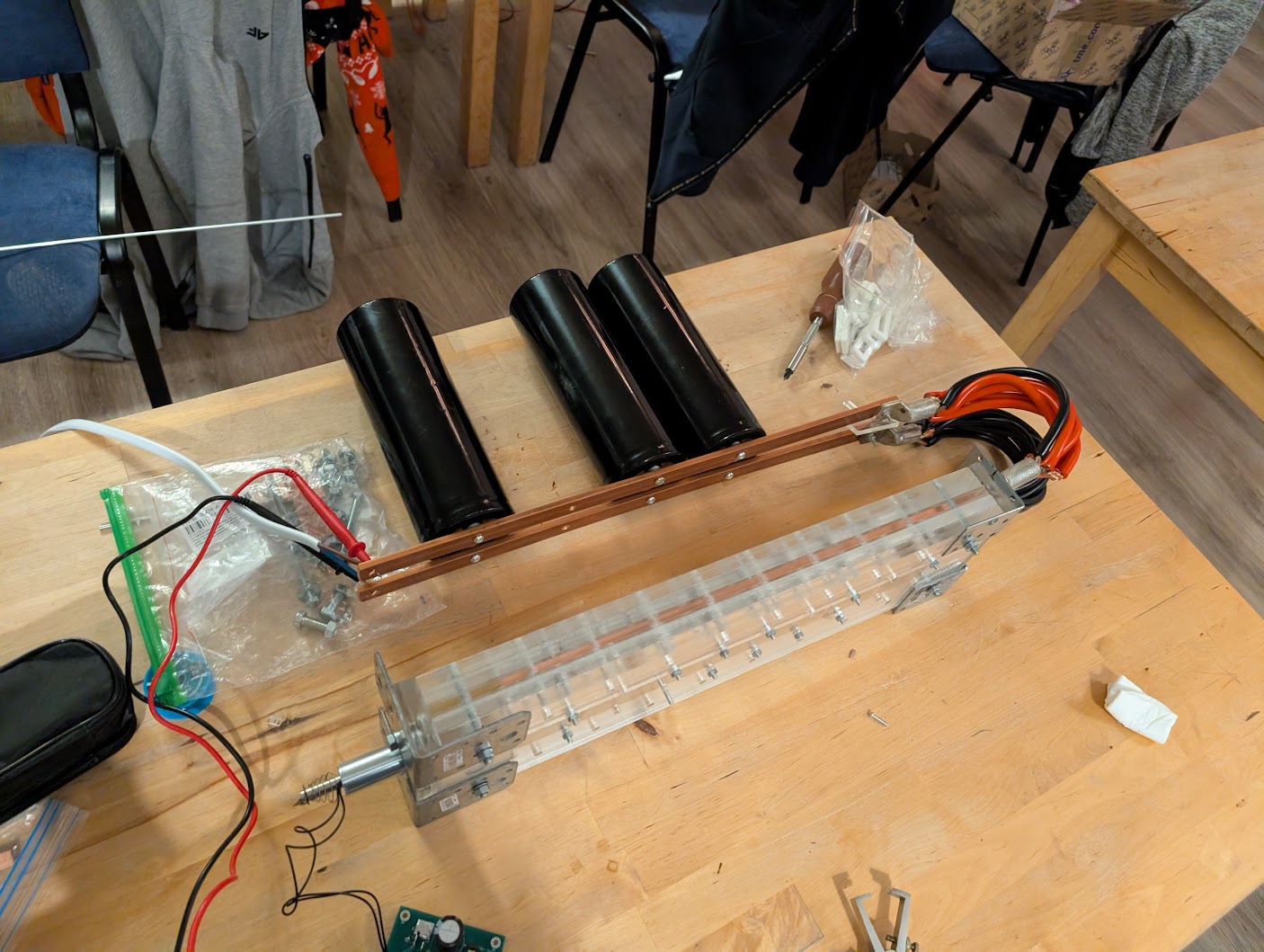
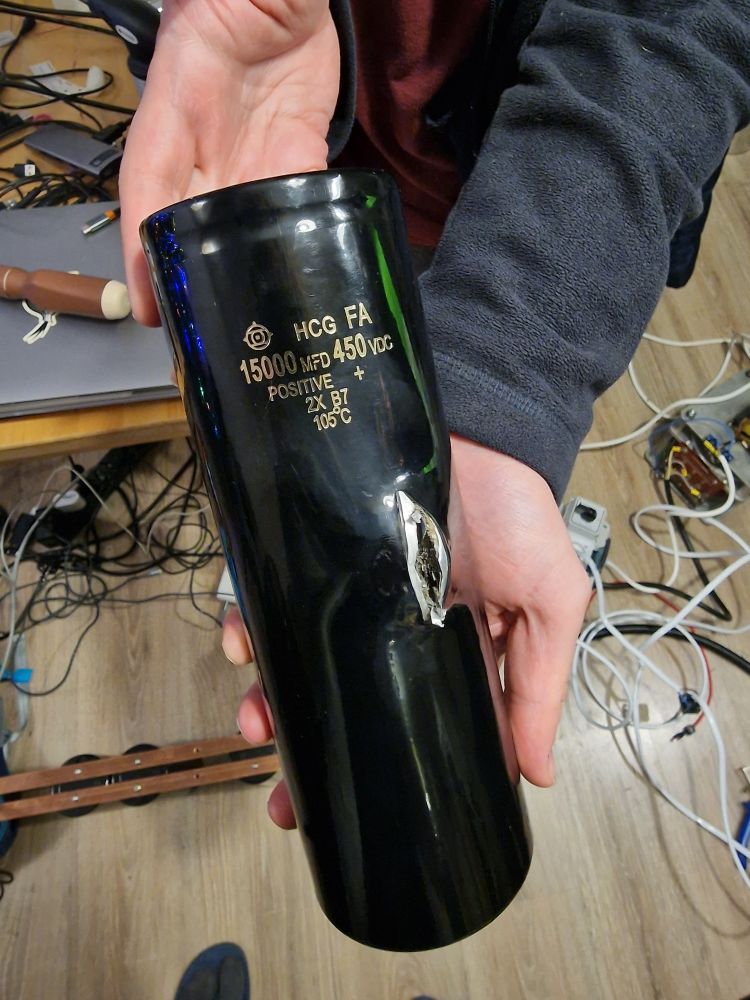
As you can see, one capacitor is missing. Sadly, during the fun, it exploded…
What’s left to discuss is the projectile injection system, which NEEDS IMPROVEMENT. In this revision, a pushing electromagnet was utilized to accelerate the bullet before it hits the copper bars. This initial speed is essential to overcome friction so that the Lorentz force might pick up before everything gets welded together. Unfortunately, here it was too low, or the projectile wasn’t polished enough, as during launch it got stuck inside, causing a molten copper explosion and welding itself to the copper bars. In the future, further experiments will be conducted to find the optimal bullet shape, copper spacing, and so on to get this to work properly. Sadly, the copper bars need a thorough refurbishment after the explosion.
Current result
Well, at least there were sparks :)